Identity and work rights
Passports, driver licences, visa grants and work-rights evidence.

Resumes and job descriptions arrive in different formats, languages and layouts. Turning them into consistent candidate and role data by hand slows product experiences and recruiter workflows.
Identity documents, work-rights evidence, licences, qualifications and checks must be collected and reviewed before a candidate can start. Missing or inconsistent evidence creates rework and placement risk.
Contractor packs, timesheets, rate cards and invoices create repetitive data entry across recruitment, payroll and finance systems long after a candidate has been selected.
Passports, driver licences, visa grants and work-rights evidence.
Qualifications, registrations, tickets, police checks and working-with-children checks.
Tax, superannuation, bank, insurance and other contractor onboarding forms.
Timesheets, client job orders, rate cards, supplier invoices and supporting records.
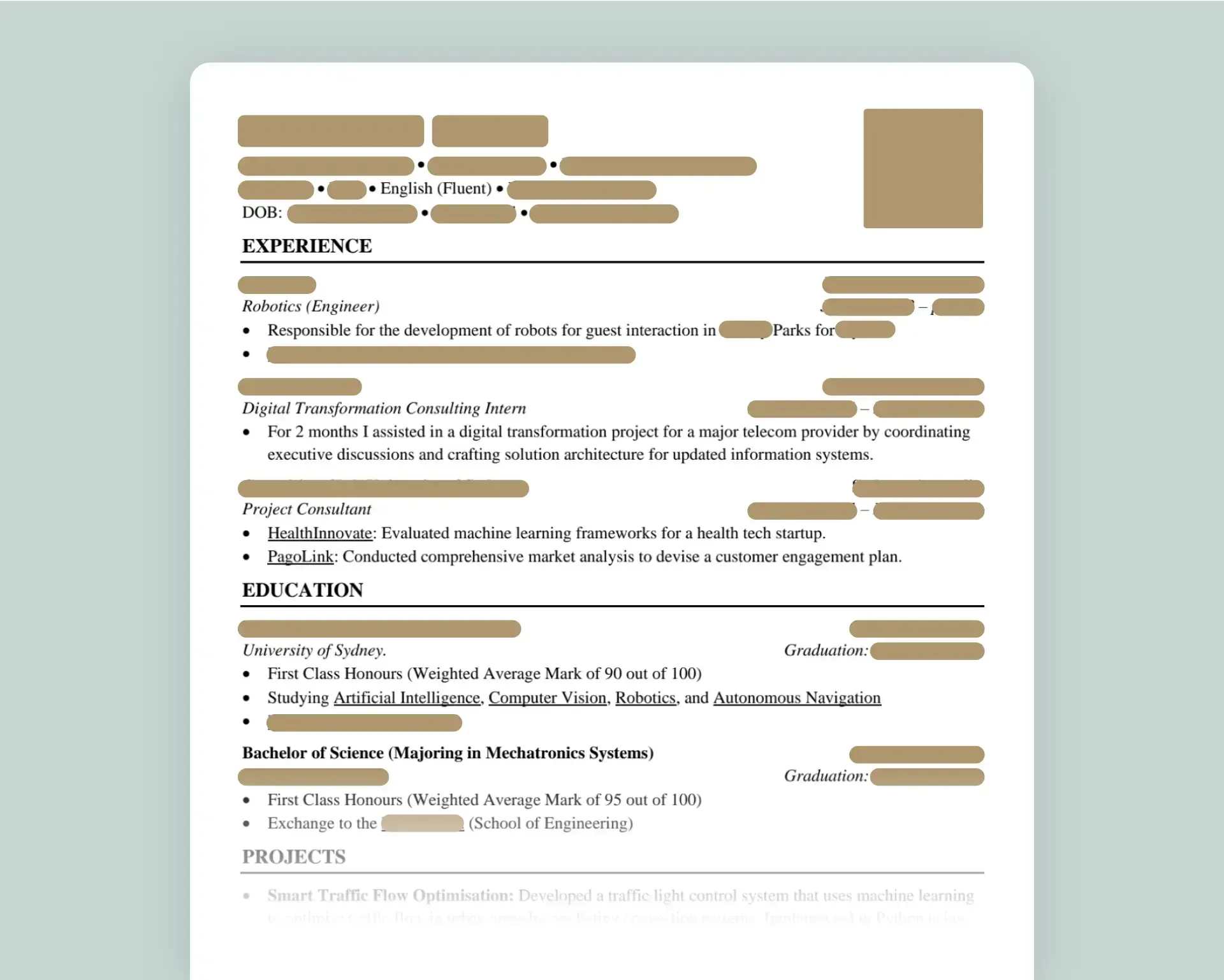
Blind hiring does not remove every source of bias, but redacting the right details gives every reviewer a more consistent starting point.
Anonymise resumes before screening with CV redaction software that hides the fields likely to sway an early assessment, while keeping skills and experience in full view.


High accuracy parsing across multiple languages
Improved customer experience thanks to better structured data
Stronger compliance with international data security and software standards


faster onboarding for jobseekers
resumes parsed annually
Enterprise-grade compliance, privacy and security needs met


resumes parsed and indexed annually
recruiters using the Aqore platform
accuracy on key resume fields
Recruitment document automation turns resumes, identity files, work-rights evidence, qualifications, onboarding forms, timesheets and other recruitment documents into structured, validated data. It can classify files, extract required fields, check them against configured rules, route exceptions for review and prepare the results for ATS, HR, payroll and finance systems.
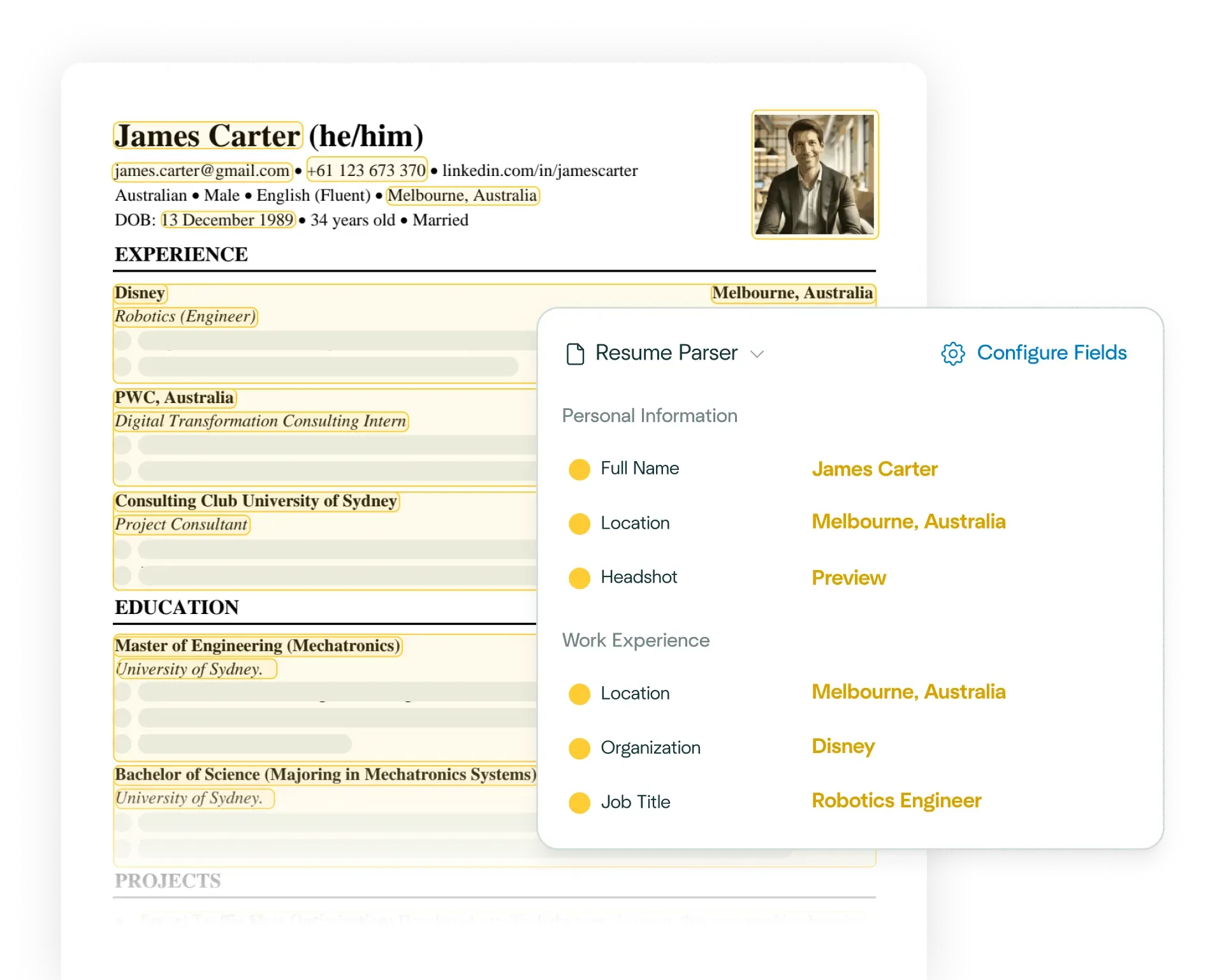
A resume parser turns resumes and CVs into structured candidate data such as skills, work history, education and contact details. A purpose-built parser suits ATS, job boards and HR technology products that need a stable API, consistent fields and high-volume processing without maintaining parsing infrastructure in-house.
Learn more about resume parsing technology transforming recruitment platforms.
Yes. Affinda can parse resumes and CVs, structure role data from job descriptions, redact selected candidate information and support search and matching workflows. Explore our industry-leading Resume Parser with job description parser functionality and Resume Redactor solutions.
Yes. Affinda’s resume search and match capabilities let you search parsed resumes using a job description or your own criteria and rank candidates by relevance. Detailed results can show how each resume matches the search criteria and where information may be missing, helping recruitment platforms and ATS providers build more useful candidate discovery and matching experiences. If you'd like to learn more about our search and match functionality, talk with our team.
The Resume Parser API receives a candidate document and returns structured data that can be mapped into an ATS, CRM, HRIS or recruitment product. Affinda offers hosted and self-hosted deployment options, so product teams can choose where parsing runs while building against a consistent API. See the Resume Parser for technical details and a live test.
ATS and HR-tech providers can automate the operational paperwork around candidates, contractors and placements without building a separate processing system. The Affinda Platform can classify mixed document packs, extract the fields each workflow needs, validate them against configured rules, route exceptions for review and prepare the resulting data for downstream recruitment and workforce systems.
Resume parsing is a specific candidate-intake capability that converts resumes and CVs into structured data. Recruitment workflow automation covers the wider document process, including classification, extraction, validation, exception review and write-back across candidate, compliance, onboarding and placement documents.
Product teams can use the Resume Parser for high-volume resume data at 0.05 seconds per resume, or the Affinda Platform for broader recruitment document workflows.
Affinda can be configured for passports, driver licences, visa grants and work-rights evidence, qualifications, registrations, tickets, police checks, working-with-children checks, contractor onboarding forms, insurance certificates, timesheets, client job orders, rate cards and supplier invoices. The Affinda Platform is designed for workflows that span multiple document types and layouts.
Yes. Affinda can extract identifying information, document numbers, issue dates and expiry dates, then validate those values against your configured rules and flag missing, expired or inconsistent evidence for review. Affinda does not replace an authoritative government or registry check; it helps prepare and route the document evidence used in that process.
ATS workflow automation can move validated candidate and placement data into the systems your team already uses. Affinda prepares data for ATS, CRM, onboarding and payroll systems through APIs, configured exports and integrations.
If you’re looking for a solution that builds workflows beyond resume parsing, such as staffing, RPO, talent and onboarding teams, take a look at the Affinda Platform. It handles multiple document types, validation rules and exceptions to automate recruitment processes at scale.
Yes. Affinda is designed to add document processing to an existing ATS, HR platform or recruitment product rather than replace it. Documents can enter through an API, upload, email or integration, and the resulting data can be transformed to match the fields and formats expected by downstream systems.
Take a look at our blog, Intelligent document processing use cases, to see how document processing extends beyond resumes to identity, compliance, onboarding and other recruitment workflows.
Providers should look for encryption, access controls, auditability, regional hosting and deployment flexibility. Affinda is ISO 27001:2022 certified and SOC 2 Type 2 compliant, offers regional hosting for the hosted Resume Parser and supports self-hosted parsing where documents need to remain inside the provider's infrastructure. Learn more about security and deployment.
Resume redaction can remove selected personal details before a resume reaches a reviewer, helping ATS and HR-tech providers support blind-screening workflows. Teams choose which information to redact and how the redacted document is used within their process.
Read our blog, What is a blind resume and how does it help reduce hiring bias?, to understand which candidate details blind hiring removes and how resume redaction can support a fairer screening workflow.
A job description parser turns role descriptions into structured requirements such as job title, skills, experience and qualifications. ATS, job board and HR-tech providers can use that role data alongside structured candidate data in search, matching and recruitment workflows.
Teams define the fields and validation rules each document type must pass. Clean documents can continue through the workflow, while missing, ambiguous or inconsistent data is routed to review with the source document attached. This keeps people focused on exceptions and decisions rather than rekeying every file.